
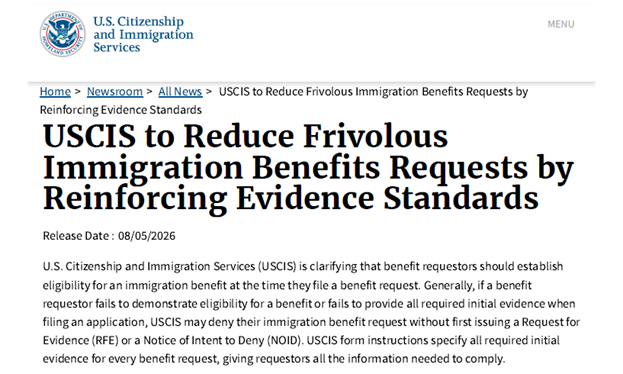
USCIS Announces Tougher Evidence Standards
On August 5, 2026, USCIS announced a major policy change titled “USCIS to Reduce Frivolous Immigration Benefits Requests by Reinforcing Evidence Standards.” Under this policy, applicants are expected to establish eligibility and submit all required evidence at the time of filing. USCIS stated that officers may deny applications that are incomplete, unsupported, or missing required initial evidence without first issuing a Request for Evidence (RFE) or Notice of Intent to Deny (NOID).
For immigrants and their families, this means the margin for error has become much smaller.
What Does This Mean for Immigration Applicants?
In the past, many applicants who made mistakes or forgot to include required documents often received an RFE giving them an opportunity to correct the problem.
Today, that may no longer happen.
USCIS has restored officers’ discretion to deny applications immediately when the applicant fails to establish eligibility or does not submit all required initial evidence.
In practical terms, your case may be denied if:
- You complete the immigration forms incorrectly;
- You fail to include required supporting documents;
- You overlook a required signature;
- You submit insufficient evidence;
- You fail to establish eligibility at the time of filing;
- You miss a required filing requirement listed in the form instructions.
A Denial Can Cost More Than Just Time
Many applicants focus solely on whether their case will be approved.
However, a denial can trigger several costly consequences.
1. You May Lose Your Filing Fees
USCIS filing fees are generally non-refundable.
If your case is denied because it was incomplete, improperly prepared, or missing evidence, USCIS will typically keep the filing fees you already paid.
If you choose to refile, you will likely need to pay new filing fees.
2. You May Need a New Immigration Medical Exam
Many immigration applicants must submit Form I-693, Report of Immigration Medical Examination and Vaccination Record.
Depending on the circumstances, a denied case may require the applicant to obtain a new medical examination before refiling.
This can result in hundreds of dollars in additional costs.
3. Delays Can Become Much Longer
A denied application often means starting over from the beginning.
This may involve:
- Preparing a new application package;
- Gathering updated evidence;
- Paying new government filing fees;
- Waiting through another round of USCIS processing.
For some families, a mistake that could have been corrected through an RFE in the past may now result in months or even years of additional delay.
The Immigration Consequences May Be Even More Serious
The financial impact of a denial is often only part of the problem.
Many immigrants are unaware that a denied application can have immigration enforcement consequences.
As discussed in USCIS Policy Memorandum PM-602-0187, USCIS may issue or refer a case for a Notice to Appear (NTA) when an applicant’s benefit request is denied and the individual is no longer lawfully present in the United States. A Notice to Appear is the document that initiates removal proceedings before an Immigration Judge.
In other words, for some applicants, a denial may lead not only to the loss of filing fees, but also to referral for immigration court proceedings.
Common Examples We Worry About
The danger is that applications are not always denied because the applicant was ineligible.
Sometimes cases are denied because:
- The wrong document was submitted;
- A required document was omitted;
- A notice was overlooked;
- The applicant failed to respond to a USCIS request;
- The application was prepared incorrectly;
- USCIS concluded that the evidence submitted was insufficient.
Under the current policy environment, these types of mistakes may have much greater consequences than they did in previous years.
Why Hiring an Immigration Attorney Matters More Than Ever
This policy places tremendous importance on submitting a complete application package the first time.
Applicants should no longer assume that USCIS will issue an RFE and provide an opportunity to correct deficiencies.
By the time you receive a denial notice, the damage may already be done.
An experienced immigration attorney can help:
- Review eligibility before filing;
- Identify missing evidence;
- Organize supporting documentation;
- Prepare legal explanations when necessary;
- Monitor notices and case developments;
- Reduce the risk of avoidable denials.
Practical Tips for Applicants
Review Every Form Carefully
Simple mistakes, inconsistent answers, or missing information can create significant problems.
Submit All Required Initial Evidence
Do not assume USCIS will later request missing documents.
Keep Copies of Everything
Maintain complete copies of all applications, supporting evidence, notices, and correspondence.
Respond Immediately to USCIS Notices
If USCIS does issue an RFE or NOID, do not delay responding.
Consult an Immigration Attorney
The cost of professional guidance is often far less than the cost of refiling an application, obtaining a new medical examination, and potentially defending against removal proceedings.
The Bottom Line
USCIS has made it clear that applicants must establish eligibility and submit all required evidence when they file. Cases that are incomplete, improperly prepared, or unsupported may be denied without an RFE or NOID.
For many applicants, a denial now carries consequences that extend far beyond losing filing fees. Depending on the circumstances, a denial may require the applicant to repay filing fees, obtain a new medical examination, restart the process, and potentially face referral to ICE and removal proceedings under USCIS’s current NTA policy.
For more information on USCIS to Reduce Frivolous Immigration Benefits Requests by Reinforcing Evidence Standards a consultation is your next best step. Get the information and legal answers you are seeking by calling (281) 777-1236 today!
Common Questions We Can Help You With
- Can USCIS deny my case without issuing an RFE?
- What is the USCIS evidence standards policy announced on August 5, 2026?
- What happens if I submit an incomplete immigration application?
- Will USCIS refund my filing fees if my case is denied?
- Do I need a new medical exam if my immigration case is denied?
- Can USCIS refer a denied case to ICE?
- Can a green card denial result in removal proceedings?
- What is USCIS PM-602-0187?
- What is a Notice to Appear (NTA)?
- Can missing evidence cause an immediate denial?
- What happens if I forget to submit required documents?
- Can USCIS deny my I-485 without an RFE?
- What happens if my Adjustment of Status application is denied?
- Can a denied immigration application affect my ability to stay in the United States?
- Why are immigration applications being denied more quickly?
- How can I avoid an immigration application denial?
- What evidence must be submitted with an immigration application?
- Should I hire an attorney before filing with USCIS?
- Can I refile my case after a denial?
- What are the consequences of a USCIS denial in 2026?

Call For A Free Consultation*
(281) 777-1236